


Market Insight- Global Reefer Containers Market Overview 2026
Global Reefer Containers Market Was Valued at USD 2.222 billion in 2025 and is Expected to Reach USD 3.969 billion by the End of 2035, Growing at a CAGR of 5.97% Between 2025 and 2035.– Bossonresearch.com
Reefer containers are temperature-controlled intermodal units that move perishable and temperature-sensitive cargo by sea, rail, or road. An insulated box body and an integrated refrigeration unit maintain set temperature, humidity, and airflow throughout transit, which is what separates a reefer from a standard dry container. Modern designs add digital monitoring, remote control, and energy-efficient cooling that turn the unit into a traceable cold-chain asset rather than a passive box. Demand therefore follows perishable food trade, cold-chain infrastructure build-out, and the replacement of ageing reefer fleets, while equipment capacity is constrained by the reefer plug positions fixed to each vessel at build time.

In 2025, the global reefer container market reached USD 2.222 billion and is projected to expand to USD 3.969 billion by 2035, growing at a CAGR of 5.97%. In volume terms, sales rise from 377.2 K TEU to 615.1 K TEU over the same period, a 5.01% annualised increase. The 2020-2024 record was volatile: revenue fell from USD 2.027 billion in 2021 to USD 1.318 billion in 2023, then recovered to USD 2.222 billion in 2025. Average ex-factory pricing has settled at USD 5,892 per TEU, above the USD 4,428 recorded in 2020, so the 2025 upswing reflected both volume recovery and a richer equipment mix.
Three structural constraints define the outlook. Demand is tied to perishable trade flows rather than discretionary spending, which makes volumes relatively resilient but limits the pace of expansion. Supply is governed by a physical constraint, since reefer plugs cannot be added to a vessel in normal operation, so incremental capacity requires newbuild or conversion. Manufacturing is concentrated, with a CR5 of 92.81% and an HHI of 35.55%, which limits how quickly a second supplier can absorb a large order. Refrigerant regulation adds a further layer, as EU F-gas rules tighten the cost of placing and servicing high-GWP equipment on the market.
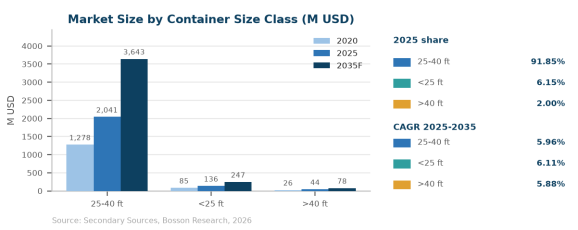
The reefer container market is primarily segmented by container size class into 25-40 ft, <25 ft, and >40 ft. The 25-40 ft class accounts for 91.85% of global revenue in 2025, because the 40-ft High Cube unit combines high payload volume with standardised intermodal compatibility and dominates the main trade routes. The <25 ft class, made up mainly of 10-ft and 20-ft units for short-haul distribution, cold storage, and smaller consignments, carries the fastest CAGR at 6.11% from a low base. The >40 ft class remains marginal at 2.00% of revenue, since non-standard dimensions are not compatible with mainstream port, vessel, and rail handling infrastructure.
Table 1 Global reefer containers market by container size class, 2025 and 2035F (US$ million)
|
Segment |
2025 |
2035F |
Share 2025 |
CAGR 25-35 |
|
25-40 ft |
2,041 |
3,643 |
91.85% |
5.96% |
|
<25 ft |
137 |
247 |
6.15% |
6.11% |
|
>40 ft |
44 |
79 |
2.00% |
5.88% |
|
Total |
2,222 |
3,969 |
100.00% |
5.97% |
Source: Bosson Research analysis, 2026.
From an application perspective, the market is segmented into Fruit, Dairy Products and Eggs, Meat Products, Marine Products, Processed Food & Beverages, Vegetables, Fresh Flowers, and Others. Fruit is the largest individual application at 16.89% of 2025 revenue, followed by Dairy Products and Eggs at 12.98%, and remains the anchor lane for reefer demand on agricultural export routes. Processed Food & Beverages is the fastest-growing application with a CAGR of 6.39%, reflecting the internationalisation of frozen and chilled food supply chains. The Others category, at 13.77%, is the slowest at 4.94% because a portion of pharmaceutical cold-chain volume is served by specialised air freight and active packaging rather than ocean reefers.
Table 2 Global reefer containers market by application, 2025 and 2035F (US$ million)
|
Application |
2025 |
2035F |
Share 2025 |
CAGR 25-35 |
|
Fruit |
375 |
682 |
16.89% |
6.15% |
|
Dairy Products and Eggs |
288 |
503 |
12.98% |
5.73% |
|
Meat Products |
287 |
517 |
12.89% |
6.08% |
|
Marine Products |
253 |
459 |
11.38% |
6.14% |
|
Processed Food & Beverages |
282 |
525 |
12.71% |
6.39% |
|
Vegetables |
223 |
407 |
10.02% |
6.23% |
|
Fresh Flowers |
208 |
380 |
9.36% |
6.22% |
|
Others |
306 |
496 |
13.77% |
4.94% |
|
Total |
2,222 |
3,969 |
100.00% |
5.97% |
Source: Bosson Research analysis, 2026.

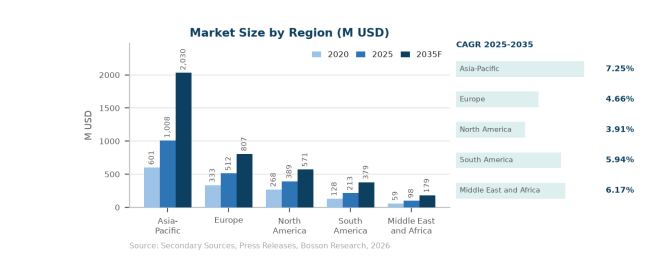
Geographically, Asia-Pacific remains the largest market with 45.39% of global revenue in 2025, followed by Europe at 23.05% and North America at 17.51%. Asia-Pacific is also the primary growth engine, expanding at a leading CAGR of 7.25% through 2035, supported by its role in global agricultural and seafood trade, large-scale food processing, and the concentration of container manufacturing itself. North America records the slowest growth at 3.91%, reflecting a mature reefer fleet and established cold-chain infrastructure. South America grows at 5.94% on agricultural and seafood exports, while the Middle East and Africa expands fastest from a small base at 6.17%.
Table 3 Global reefer containers market by region, 2025 and 2035F (US$ million)
|
Region |
2025 |
2035F |
Share 2025 |
CAGR 25-35 |
|
Asia-Pacific |
1,009 |
2,031 |
45.39% |
7.25% |
|
Europe |
512 |
808 |
23.05% |
4.66% |
|
North America |
389 |
571 |
17.51% |
3.91% |
|
South America |
213 |
380 |
9.60% |
5.94% |
|
Middle East and Africa |
99 |
180 |
4.44% |
6.17% |
|
Total |
2,222 |
3,969 |
100.00% |
5.97% |
Source: Bosson Research analysis, 2026.
Reefer Containers Industry Chain Analysis

Service Process Analysis of Reefer Containers
Solution Planning and Delivery
Reefer container production begins with specification definition, which balances the carrier's route profile, the cargo's temperature and atmosphere requirements, the vessel plug positions, and the target cost. Designs then move through structural fabrication, foaming and insulation, refrigeration-unit integration, and quality verification before release.
Delivery capability takes shape in dedicated reefer production lines and qualified assembly teams, where foaming, box assembly, and refrigeration-unit integration are performed under controlled conditions. Reefer manufacturing carries more process complexity than dry-container production, with specialised foaming, higher skilled-labour requirements, and tighter documentation for the refrigeration unit.
Digital tooling shapes this stage as well. Demand forecasting, specification data, and production-line digitalisation improve material purchasing and scheduling, while the January 2026 order for 5,000 reefer units carrying a controlled-atmosphere system shows how programme-scale orders are handled directly.
Once builds are confirmed, they move through documentation, inspection, and staged release before dispatch, with quality checkpoints and pre-delivery testing protecting integrity up to the point of delivery.
Logistics and Customer Delivery
Logistics is the connective tissue of the reefer value chain. Container manufacturers ship to carrier yards, leasing depots, and repair stations across Asia, Europe, and the Americas, and repositioning empty reefers between trades is part of the cost structure that total-cost-of-ownership buyers evaluate.
Development Trends
IoT Deployment Is Reshaping the Cold Chain Data Infrastructure
Digitalization of reefer containers is evolving beyond basic GPS tracking and temperature monitoring toward real-time condition management, predictive analytics, and actionable intelligence. Maersk is currently upgrading IoT devices across its reefer fleet and expects approximately 30% of its fleet to be upgraded by June 2026. The new devices support 4G/5G connectivity, enhanced processing capabilities, and solar energy harvesting. Maersk has explicitly stated its ambition to transform the technology from a visibility tool into an intelligent solution capable of interpreting data and recommending actionable interventions. In parallel, the company has deployed a new digital connectivity platform across approximately 450 vessels, establishing a broader infrastructure for onboard data collection.
This shift is being driven by the fact that real-time data availability has evolved from a value-added feature into an increasingly essential requirement for cold-chain customers. Since Maersk launched its Captain Peter visibility platform in 2019, customers have become accustomed to end-to-end monitoring from container sealing through final delivery. The company's next step is to transform Captain Peter from a visibility platform into an intelligent decision-support tool that interprets operational data and provides actionable recommendations. To support this transition, Maersk has simultaneously deployed its next-generation digital connectivity platform across approximately 450 vessels, providing the underlying infrastructure for onboard data collection and transmission.
This transformation is occurring across major shipping lines rather than being limited to a single operator. Hapag-Lloyd has equipped its reefer fleet with smart monitoring systems capable of tracking temperature, humidity, oxygen, carbon dioxide, and location, while CMA CGM offers smart reefer solutions that provide near-real-time monitoring of temperature, GPS location, humidity, oxygen, carbon dioxide, and power status. The competitive implications are significant: connectivity is increasingly becoming a baseline capability of premium reefer equipment rather than a standalone value-added feature.
IoT deployment in reefer containers is therefore entering a phase of continuous technological iteration. Standardized data collection could enable interoperability of cold-chain data across carriers, while enhanced edge-computing capabilities may shift anomaly management from post-event reporting toward real-time intervention. Operators that achieve fleet-wide standardization of connected equipment earlier are likely to gain advantages in data quality, operational visibility, and customer experience.
Structural Expansion of Reefer Capacity
According to Alphaliner data reported in April 2026, the reefer capacity of the world's ten largest liner shipping companies increased by 7.9% over the preceding 12 months. This growth significantly exceeded the expansion rate of the global container fleet, indicating that refrigerated transportation is increasingly shifting from an ancillary service toward a strategic growth segment.
MSC led the expansion, adding nearly 100,000 reefer plugs, representing a year-on-year increase of 15.3%, compared with 13.1% growth in its overall fleet. Its total reefer plug capacity exceeded 700,000. ONE also recorded strong growth, with reefer capacity increasing by 14.5%, well above its overall fleet growth of 5.9%, making it the first Asian liner to have reefer capacity account for more than 20% of its total container fleet, a level previously associated primarily with leading European carriers. Maersk and CMA CGM continued to rank among the industry leaders in terms of reefer capacity share.
This structural expansion is supported by the recovery of global perishable-goods trade. Drewry forecasts global seaborne reefer trade at approximately 156 million tonnes in 2026, representing annual growth of nearly 3.7%, following two consecutive years of contraction. The balance between cargo growth and capacity expansion will be a key determinant of reefer supply-demand conditions over the coming years. Importantly, reefer plug capacity represents a relatively fixed physical constraint at the vessel level: unlike dry containers, which can be flexibly repositioned to adjust capacity, additional reefer plugs cannot generally be added to a vessel during normal operations. As a result, structural increases in reefer capacity typically require new vessel construction or vessel modification, resulting in lower supply elasticity than in the dry-container segment.
Structural Expansion of Perishable Food Trade
The cross-border trade of fresh produce, meat, seafood, fruits, and other perishable products continues to represent the fundamental demand base for reefer containers. Drewry's 2026 Reefer Shipping Annual Review continues to place global perishable-goods trade at the center of its industry analysis, covering 15 major commodity groups and 40 products, including meat, bananas, fish and seafood, vegetables, citrus fruits, berries, and dairy products, while tracking major international trade lanes and five-year cargo forecasts. Historical trends also indicate that as the specialized reefer fleet ages, a growing share of cargo is shifting toward containerized transportation, further strengthening structural demand for containerized reefer capacity.
At FRUIT LOGISTICA in February 2026, Drewry reefer market analyst Philip Gray disclosed that global seaborne reefer cargo volumes increased from approximately 60 million tonnes in 2000 to 143 million tonnes in 2025, representing a 139% increase over 25 years. Gray further forecast that global seaborne reefer cargo could approach 160 million tonnes by around 2030. In a March 2026 analysis, Robert F. Sappio, CEO of SeaCube Container Leasing, noted that reefer trade grew by approximately 6% in 2025, supported by fresh food and protein products, and projected continued growth through 2029 at a CAGR of approximately 4%.
This driver has strong long-term resilience because reefer cargo is directly linked to food consumption and international agricultural trade, rather than being solely dependent on manufacturing cycles. Over the next three to five years, major agricultural trade lanes, including South America–Asia, South America–Europe, North America–Asia, and Asia–Europe, are expected to remain important sources of demand. At the same time, continued containerization of perishable cargo should allow incremental trade volumes to translate more directly into demand for reefer container equipment and vessel reefer plug capacity.
Reducing Food Loss Is Strengthening the Economic Case for Cold Chains
Food-loss reduction is becoming an increasingly important economic rationale for cold-chain investment. FAO reported in 2026 that approximately 526 million tonnes of food are lost or wasted globally each year due to inadequate refrigeration, equivalent to around 12% of total global food production. In developing economies, cold-chain technologies could theoretically prevent approximately 144 million tonnes of food waste annually. This highlights a shift in the value proposition of reefer containers: beyond maintaining low temperatures during transportation, they increasingly serve to reduce cargo losses, extend shelf life, and expand the geographic radius of trade.
A cold-chain rail-sea service in Ningxia, China, for example, uses a single reefer container throughout the rail-to-sea transportation process, eliminating more than three cargo-handling transfers. The operation reportedly reduced logistics costs by approximately 15% and lowered the spoilage rate of frozen beef and mutton from around 12% to below 3%. Leading carriers such as Maersk have also combined Controlled Atmosphere (CA), Controlled Ripening, and real-time monitoring to improve cargo preservation for products such as bananas, with its StarRipe solution specifically addressing longer-distance transportation and ripening management.
This loss-reduction logic creates a dual impact on the reefer container market. On one hand, high-value fresh-produce exporters are increasingly willing to pay a premium for more reliable cold-chain solutions, supporting demand for advanced reefer containers equipped with CA, multi-temperature capabilities, and enhanced monitoring. On the other hand, cold-chain infrastructure gaps in emerging markets are translating into new equipment demand. In Uzbekistan, for example, estimated demand for container cargo-handling facilities is approximately 945,000 square meters, compared with only around 40,000 square meters of actual capacity in 2025, indicating a substantial infrastructure gap.
The World Bank has noted that at least 25% of food production in developing countries can be lost due to inadequate cold-chain infrastructure, while an effective cold chain requires an integrated network covering cold storage, packhouses, refrigerated transportation, distribution centers, and related facilities. FAO has also highlighted energy availability as a major constraint on reliable cold-chain development in many emerging regions. One case cited by FAO indicates that 30%–40% of certain agricultural products in Jamaica can be lost because of inadequate post-harvest handling and refrigeration capacity. As modern retail, food processing, and agricultural export industries expand across Asia, Latin America, and Africa, cold-chain investment is expected to extend beyond cold storage toward cross-border transportation and international export infrastructure, creating incremental opportunities for reefer containers.
Pharmaceutical and Biologics Require Higher Temperature-Control Standards
Pharmaceuticals, biologics, vaccines, and other high-value temperature-sensitive products are increasing demand for high-reliability reefer solutions. IATA estimates that the pharmaceutical industry transports goods worth more than US$1 trillion annually, while temperature excursions can directly compromise product integrity. As a result, the sector increasingly requires specialized equipment, temperature-controlled facilities, standardized handling procedures, and end-to-end monitoring. Importantly, demand is being driven not only by pharmaceutical industry growth but also by tighter regulatory requirements, including Good Distribution Practice (GDP) standards and WHO guidelines, which are encouraging customers to adopt smart reefer solutions with real-time monitoring, comprehensive telemetry, and auditable shipment records.
Although high-value pharmaceutical products continue to rely heavily on air freight, selected pharmaceutical products suitable for ocean transportation are driving reefer shipping toward higher service standards. CMA CGM has established a dedicated Pharma Reefer Division, offering GDP-aligned transportation, 24/7 technical support, risk management, and transport data management. Its Smart Reefer solutions also provide different levels of monitoring for high-value pharmaceutical cargo. While pharmaceutical logistics is unlikely to become the largest volume driver for the overall reefer container market, it is expected to have a disproportionately strong impact on premium equipment, monitoring technologies, temperature-control precision, and specialized logistics services.
Global Reefer Containers Market: Competitive Landscape
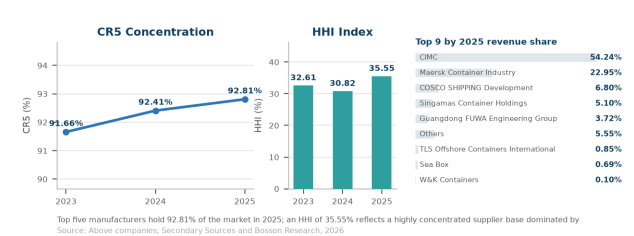
The global reefer container sector is a highly concentrated manufacturing market. The CR5 ratio stood at 92.81% in 2025 while the HHI reached 35.55%, indicating a supplier base in which a small number of established manufacturers control more than nine-tenths of global output. CIMC leads with a 54.24% revenue share, followed by Maersk Container Industry at 22.95% and COSCO SHIPPING Development at 6.80%. Concentration has intensified rather than eased, rising from a CR5 of 91.66% in 2023, and expansion of the market has not produced meaningful fragmentation among the tier below the leaders.
Table 4 Global reefer containers market concentration, 2025 (revenue share and HHI)
|
Company |
2023 |
2024 |
2025 |
Type |
|
CIMC |
42.10% |
46.57% |
54.24% |
Tier 1 |
|
Maersk Container Industry |
37.92% |
28.10% |
22.95% |
Tier 1 |
|
COSCO SHIPPING Development |
5.66% |
9.42% |
6.80% |
Tier 2 |
|
Singamas Container Holdings |
2.47% |
4.59% |
5.10% |
Tier 2 |
|
Guangdong FUWA Engineering Group |
3.51% |
3.72% |
3.72% |
Tier 2 |
|
CR5 |
91.66% |
92.41% |
92.81% |
|
|
HHI |
32.61% |
30.82% |
35.55% |
|
Source: Bosson Research analysis, 2026.

Key players in the Reefer Containers Market include:
Maersk Container Industry
COSCO SHIPPING Development
Singamas Container Holdings
Guangdong FUWA Engineering Group
TLS Offshore Containers International
Sea Box
W&K Containers
Others
Request for more information
Click to view the full report TOC, figure and tables: https://www.bossonresearch.com/yjbg
About US:
Bosson Research (BSR) is a leading market research and consulting company, provides market intelligence, advisory service and market research reports for the automobile, electronics and semiconductor, and consumer good industry. The company assists its clients to strategize business policies and achieve sustainable growth in their respective market domain.
Bosson Research provides one-stop solution right from data collection to investment advice. The analysts at Bosson Research (BSR) dig out factors that help clients understand the significance and impact of market dynamics. Bosson Research (BSR) bring together the deepest intelligence across the widest set of capital-intensive industries and markets. By connecting data across variables, our analysts and industry specialists present our customers with a richer, highly integrated view of their world.
Contact US:
Tel: +86 400-166-9288
E-mail: sales@bossonresearch.com
